WebPad
What’s going on
A wave carries energy through a medium without carrying the medium along. The particles swing back and forth in place; what travels is the motion itself.
In a transverse wave the particles move at right angles to the direction the wave travels, as on a rope or the surface of water. In a longitudinal wave they move back and forth along it, making compressions and rarefactions; sound is a longitudinal wave.
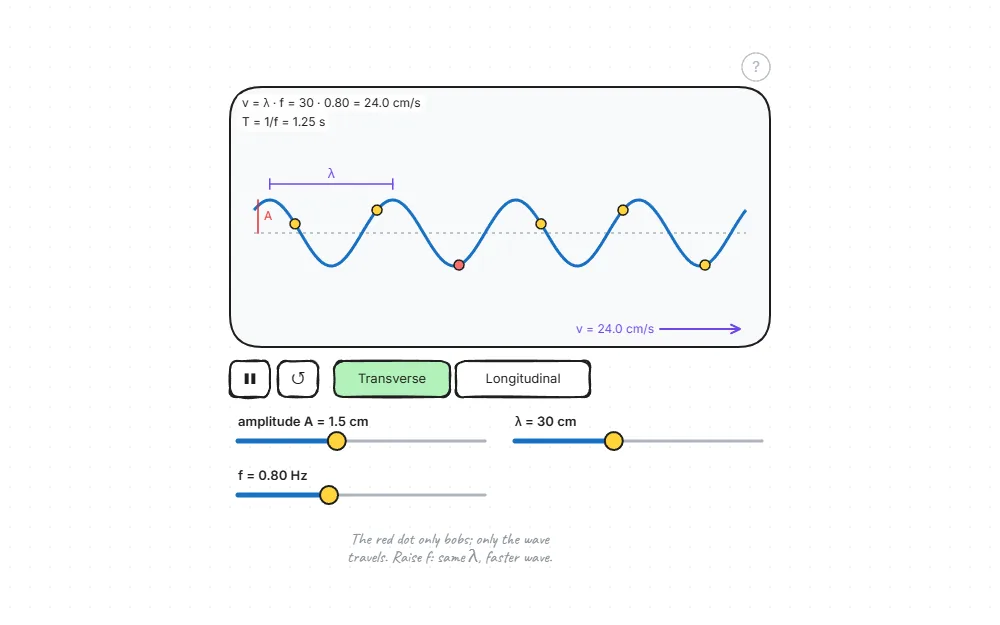
The wavelength (λ) is the distance between two crests, and the frequency (f) is how many swings there are each second. The wave’s speed is the two multiplied. The amplitude has to do with the energy a wave carries, but it doesn’t change its speed.
The formula
v = f λ · T = 1 / f
- v: wave speed
- λ: wavelength
- f: frequency, Hz
- T: period, s
Things to try
- Watch with λ = 30 cm and f = 0.8 Hz. The wave moves 24 cm each second: 30 × 0.8.
- Follow the red dot. It only moves up and down; it doesn’t travel with the wave.
- Double the frequency. With the same wavelength the wave travels twice as fast.
- Switch to “Longitudinal”. The coils swing back and forth; compressions and rarefactions move along.
- Change the amplitude. The wave gets taller or flatter but its speed doesn’t change.
Questions and answers
A wave has a wavelength of 2 m and a frequency of 5 Hz. How fast is it?
v = f × λ = 5 × 2 = 10 m/s.
Is sound transverse or longitudinal?
In air it is longitudinal: air particles vibrate back and forth in the direction the sound travels.
Why doesn’t a buoy drift to the shore as waves pass?
A wave carries energy, not water. The buoy just bobs up and down where it is.
For teachers
- Make both kinds of wave with a long spring or a rope in class and compare with the simulation.
- Have students work out the speed for a few values of λ and f and check against the wave on screen.