WebPad
What’s going on
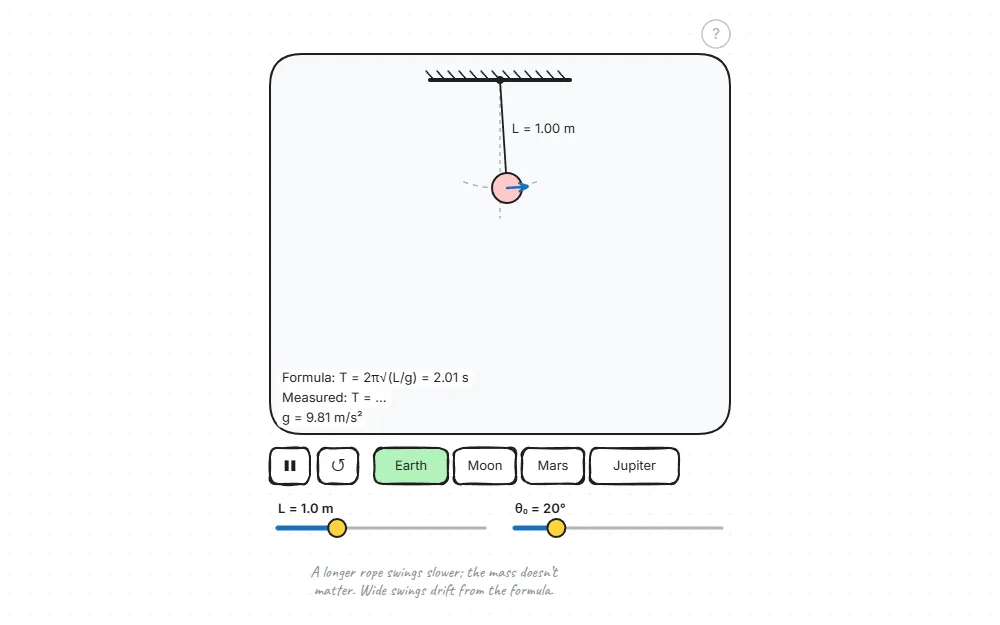
A simple pendulum is a small weight hanging on a string. Pull it to one side, let go and it swings back and forth. The time for one full swing there and back is the period.
The period depends only on the length of the string and the strength of gravity. Make the string four times longer and the period doubles. The mass of the weight makes no difference, and neither does the starting angle as long as it is small. Galileo is said to have noticed this watching a lamp swing in a cathedral.
Where gravity is weaker, a pendulum swings more slowly. On the Moon gravity is about a sixth of Earth’s, so the same pendulum takes roughly 2.5 times as long per swing.
The formula
T = 2π √(L / g)
- T: period, in seconds (s)
- L: length of the string, in metres (m)
- g: acceleration due to gravity; about 9.8 m/s² on Earth
Things to try
- Press ▶ and read the period at L = 1 m. It is about 2 seconds: 2π√(1/9.8) ≈ 2.0 s.
- Set L = 0.5 m and note the period, then set 2 m. Four times the length gives twice the period: from about 1.4 s to about 2.8 s.
- Raise the angle from 10° to 30°. The period hardly changes. At 60–80° it runs a little longer than the formula says.
- Press “Moon”. With the same string the period is about 2.5 times longer; it swings as if in slow motion.
- Press “Jupiter”. Stronger gravity: the pendulum speeds up and the period gets shorter.
Questions and answers
What is the period of a 1 m pendulum on Earth? (g = 9.8 m/s²)
T = 2π√(1/9.8) ≈ 6.28 × 0.32 ≈ 2.0 s.
If the string is made four times longer, how does the period change?
The period goes with the square root of the length: √4 = 2, so the period doubles.
Does doubling the mass on the end change the period?
No. Mass isn’t in the formula: a heavier bob is pulled harder by gravity, and the acceleration stays the same.
Why does the same pendulum swing more slowly on the Moon?
Gravity on the Moon (about 1.6 m/s²) is weaker. A smaller g makes √(L/g) bigger, so the period is longer.
Why doesn’t the formula hold exactly at large angles?
It comes from an approximation for small angles (it is very close up to about 15°). At larger angles the real period is a little longer than the formula gives.
For teachers
- Students can time ten swings and divide by ten, then compare with the value on screen.
- Plot T² against L for a few lengths: it gives a straight line, and g can be found from the slope.