WebPad
What’s going on
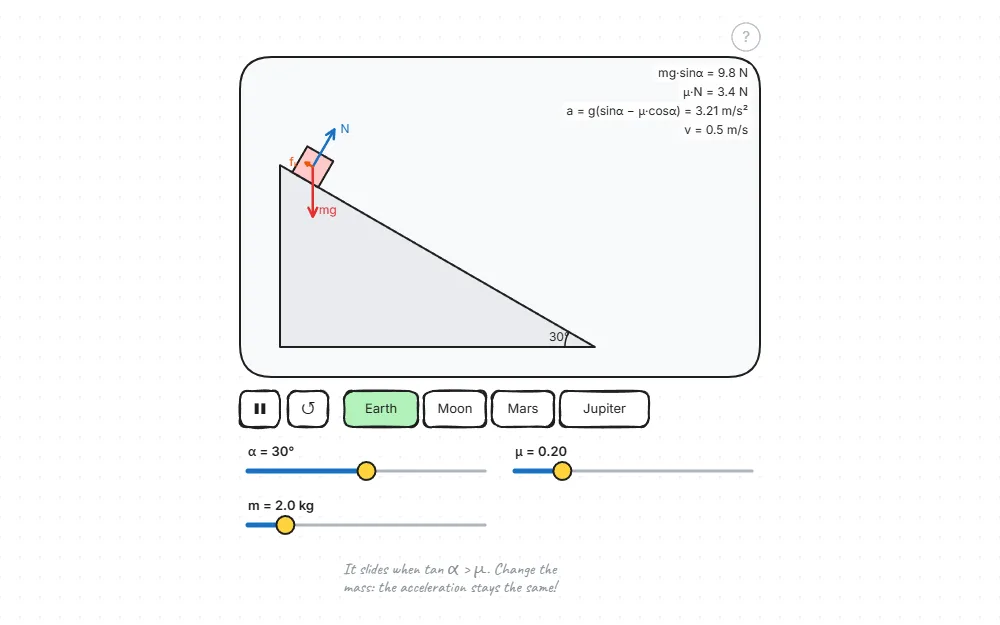
Two parts of an object’s weight act on a slope: one along the surface, pulling it down (m g sin α), and one into the surface, pressing it on (m g cos α).
Friction resists the motion and is proportional to how hard the object is pressed onto the surface. Once the pull down the slope beats the most friction can give, the object slides. That happens when tan α > μ.
The sliding object’s acceleration is a = g(sin α − μ cos α). There is no mass in it: a heavy box and a light one on the same surface slide with the same acceleration.
The formula
a = g (sin α − μ cos α)
- a: acceleration, m/s²
- α: angle of the slope
- μ: friction coefficient
- g: acceleration due to gravity, m/s²
Things to try
- Start with α = 30° and μ = 0.2. The box slides; the acceleration is about 3.2 m/s².
- Slowly lower the angle. Below about 11° the box stops sliding: tan 11° ≈ 0.2.
- Change the mass from 2 kg to 10 kg. The acceleration stays the same.
- Set μ to 0 (slippery as ice). The acceleration becomes g sin α, about 4.9 m/s² at 30°.
Questions and answers
What is the acceleration on a frictionless 30° slope? (g = 10 m/s²)
a = g × sin 30° = 10 × 0.5 = 5 m/s².
On a surface with μ = 0.5, above what angle does the object slide?
When tan α > 0.5, so above about 26.6°.
Why doesn’t doubling the mass change the acceleration?
Both the pull down the slope and the friction grow in proportion to the mass, so the mass cancels out.
For teachers
- Put an eraser on a book and tilt it slowly to find the angle where it slides; then work out μ from tan α.
- Find the sliding angle for the same μ in the simulation and compare with the class measurement.