WebPad
What’s going on
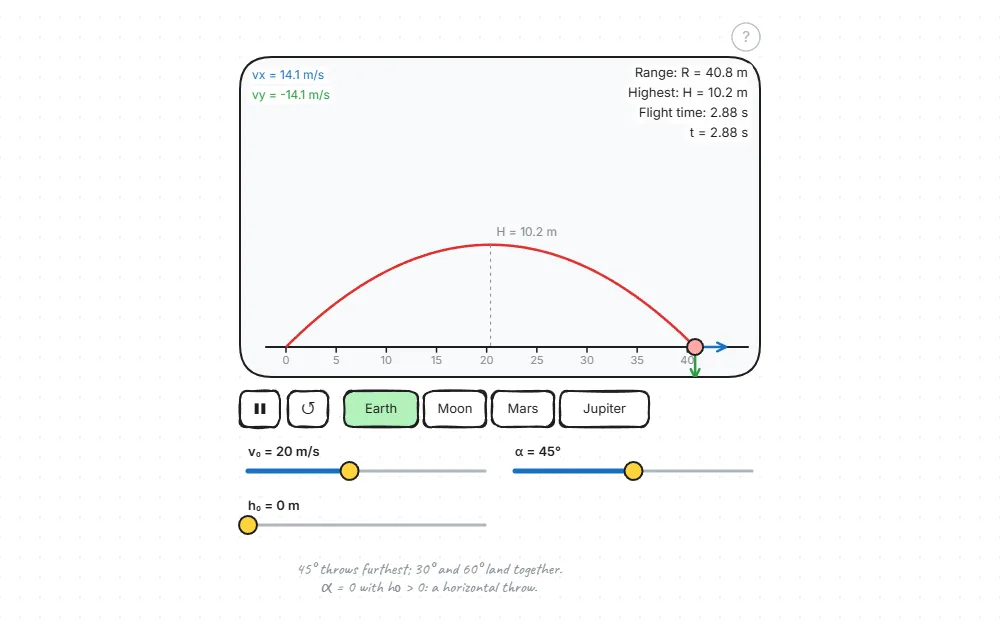
A projectile does two things at once. Sideways, its speed doesn’t change, because (leaving out air resistance) nothing pushes or slows it sideways. Up and down, gravity pulls it a little more every second. Put the two together and you get a parabola.
Launched from the ground, a projectile goes furthest at 45°. Angles that add up to 90°, such as 30° and 60°, give the same range: the steeper throw stays up longer but lands in the same place.
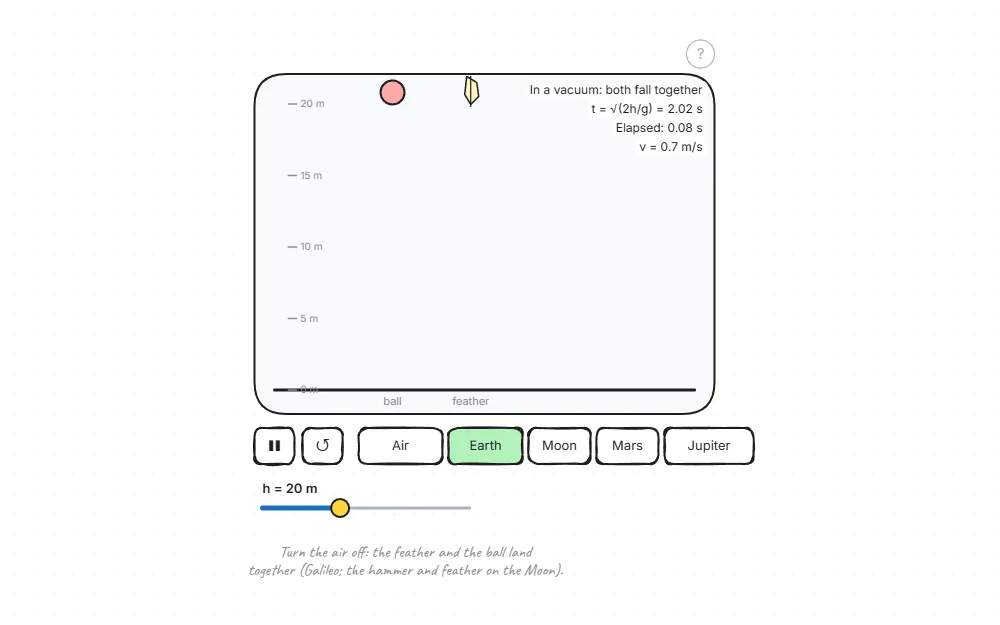
At 0° from a height it becomes a horizontal launch. How long it takes to land depends only on the height, so a ball dropped and a ball thrown sideways from the same height hit the ground together.
The formula
R = v₀² sin(2α) / g · H = (v₀ sin α)² / 2g · t = 2 v₀ sin α / g
- R: range, in metres (launched from the ground)
- H: maximum height, in metres
- t: flight time, in seconds
- v₀, α: launch speed (m/s) and angle
Things to try
- Start with v₀ = 20 m/s, α = 45°, h₀ = 0. The range is about 41 m: 20² × sin 90° ÷ 9.8 ≈ 40.8 m.
- Try 30°, then 60°. Both land in the same place (about 35 m); at 60° it goes higher and stays up longer.
- Double the speed from 20 to 40 m/s. The range goes up four times: range grows with the square of the speed.
- Set α = 0° and h₀ = 20 m. A horizontal launch: it lands after about 2 seconds whatever the speed.
- Press “Moon”. The same throw goes about six times as far.
Questions and answers
A ball is launched from the ground at 45° and 30 m/s. What is its range? (g = 10 m/s²)
R = v₀² × sin 90° ÷ g = 900 ÷ 10 = 90 m.
Two balls are launched at the same speed, one at 30° and one at 60°. Where do they land?
In the same place: sin(2 × 30°) = sin(2 × 60°) = sin 60°. The 60° ball goes higher and stays in the air longer.
An object is thrown horizontally from 20 m up. How long until it lands? (g = 10 m/s²)
t = √(2h ÷ g) = √(40 ÷ 10) = 2 s. Its sideways speed doesn’t change this.
Is the ball’s speed zero at the top of its path?
No. Its vertical speed is zero there, but it keeps its horizontal speed (v₀ cos α).
For teachers
- Ask “Which angle throws furthest?” and collect guesses, then test them in 5° steps.
- Link it to real throws: in real life air resistance shortens the range and pulls the best angle a little below 45°.