WebPad
What’s going on
Free fall is falling under gravity alone. Without air resistance everything speeds up at the same rate whatever its mass; on Earth that is about 9.8 m/s².
A feather falls slowly in everyday life because of air resistance, not because it is light. The air easily brakes a wide, light feather and hardly touches a ball.
Galileo argued this in the 1600s. In 1971 Apollo 15 astronaut David Scott dropped a hammer and a feather on the airless Moon, and they hit the ground together.
The formula
h = ½ g t² · v = g t · t = √(2h / g)
- h: height fallen, m
- t: time to fall, s
- v: speed, m/s
- g: acceleration due to gravity, m/s²
Things to try
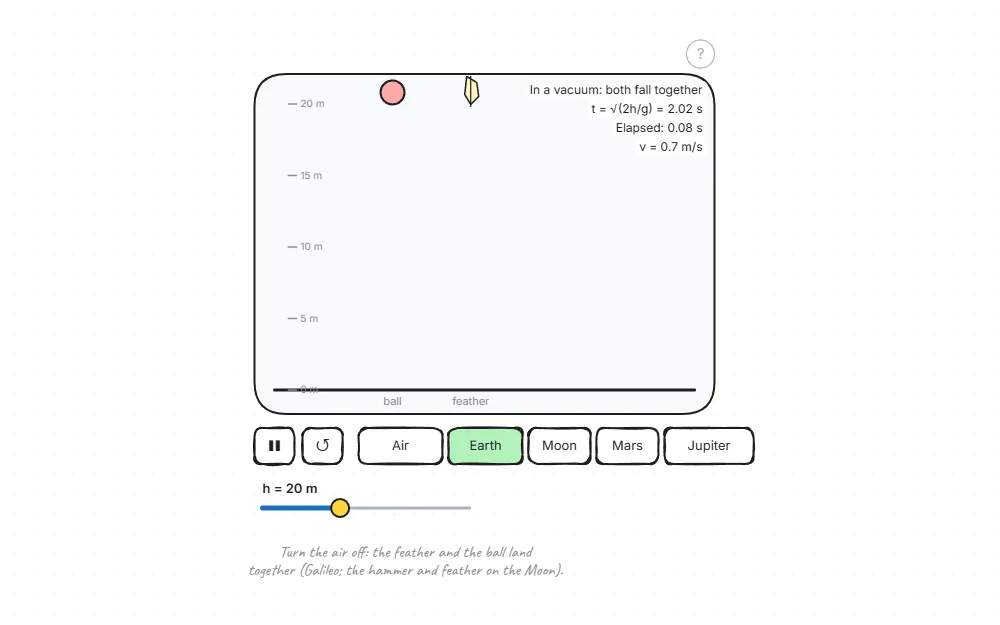
- With “Air” on, start from h = 20 m. The ball lands after about 2 seconds; the feather is far behind.
- Turn “Air” off and start again. The ball and the feather land at the same moment.
- Lower the height from 20 m to 5 m. The fall takes half as long: time goes with the square root of the height.
- Pick “Moon”. Things fall much more slowly; about 5 seconds from 20 m.
Questions and answers
A stone is dropped from 20 m. How long does it take to land? (g = 10 m/s², no air)
t = √(2h ÷ g) = √(40 ÷ 10) = 2 s.
How fast is it going when it lands?
v = g × t = 10 × 2 = 20 m/s.
Without air, why do the feather and the ball fall together?
Gravity pulls harder on the heavier object, but it is also harder to speed up. The two cancel, so the acceleration doesn’t depend on mass: a = g.
Why does a skydiver stop speeding up after a while?
Air resistance grows with speed until it equals the weight. With no net force the skydiver falls at a steady speed, the terminal velocity.
For teachers
- Drop a flat sheet of paper and a crumpled one in class, then show the airless case in the simulation.
- Record fall times for several heights and plot h against t².