WebPad
What’s going on
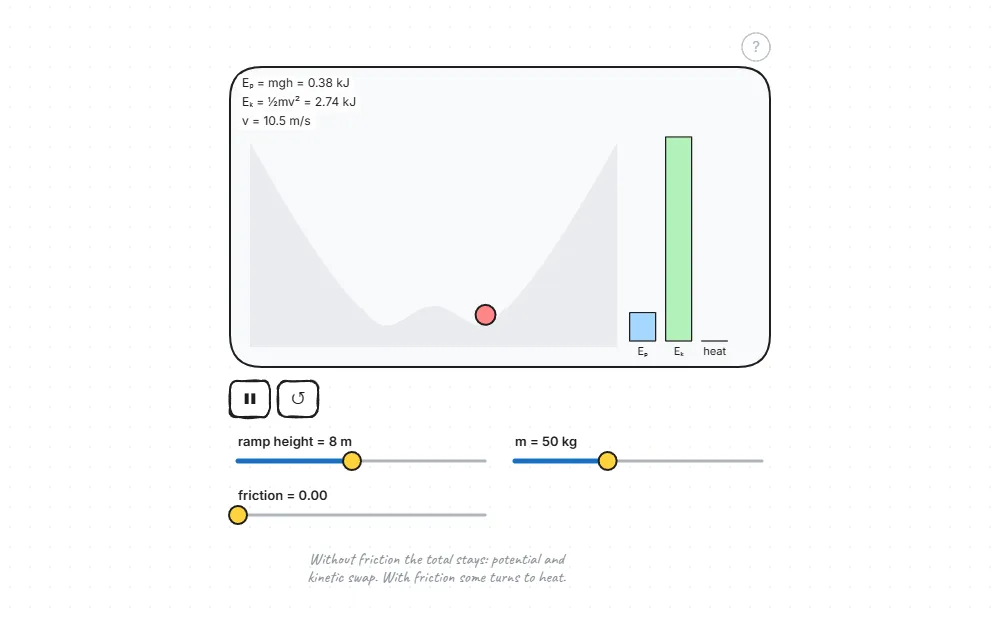
Something high up has potential energy because of where it is (Eₚ = m g h). As it comes down, that energy turns into motion: kinetic energy (Eₖ = ½ m v²).
Without friction the total mechanical energy never changes: at the bottom it is all kinetic, and climbing to the same height on the other side turns it all back into potential.
With friction some energy becomes heat. The energy isn’t destroyed, but the mechanical energy shrinks; the skater climbs a little less high each time and finally stops.
The formula
m g h = ½ m v² → v = √(2 g h)
- h: height, m
- v: speed at the bottom, m/s
- m: mass, kg (doesn’t change the speed)
Things to try
- Start with friction 0 and height 8 m. The skater climbs to the same height on the other side and the total energy bar never moves. Speed at the bottom: about 12.5 m/s.
- Raise the mass from 50 kg to 100 kg. The energies double but the speed stays the same.
- Set friction to 0.2. The heat bar grows; the skater climbs less high each time and finally stops.
- Raise the height from 2 m to 8 m. The speed at the bottom doubles: speed grows with the square root of height.
Questions and answers
What is the speed at the bottom after sliding from 5 m with no friction? (g = 10 m/s²)
v = √(2 × 10 × 5) = √100 = 10 m/s.
What is the potential energy of a 50 kg skater 8 m up? (g = 10 m/s²)
Eₚ = 50 × 10 × 8 = 4000 J.
Does friction break the conservation of energy?
No. The total energy is still kept; part of it just becomes heat, so the mechanical energy goes down.
For teachers
- Link it to roller coasters and swings: why is the first hill always the highest?
- Have students read Eₚ and Eₖ at a few points and check that they add up to the same total.