WebPad
What’s going on
Momentum is mass times velocity (p = m v), and it has a direction. Unless an outside force acts, a system’s total momentum doesn’t change, collisions included.
In an elastic collision the objects bounce apart and the total kinetic energy is kept too. In an inelastic one some energy turns into heat, sound and bent metal. In a perfectly inelastic collision they stick together and move as one.
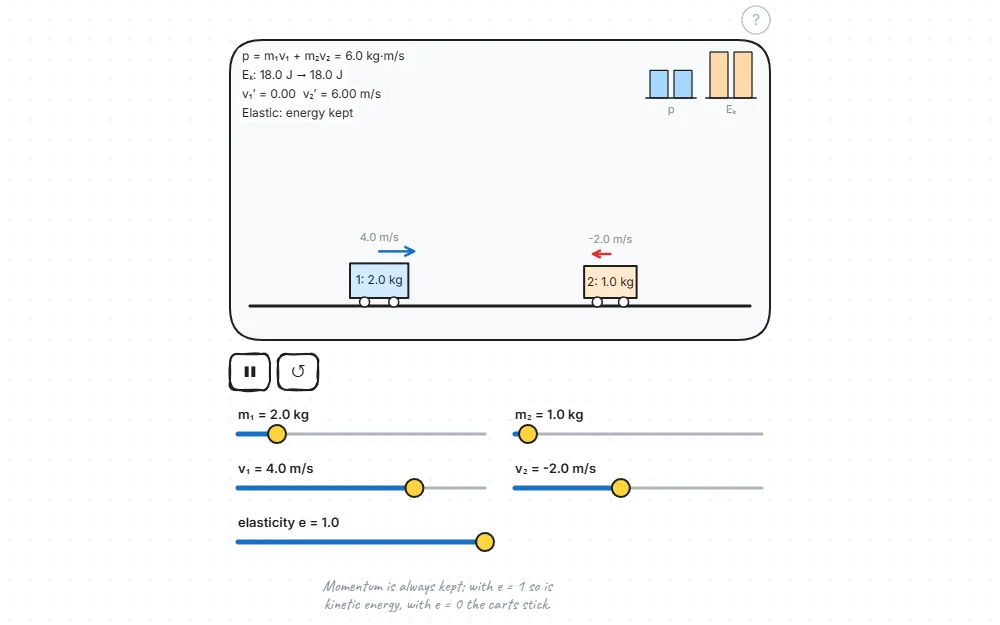
The value e in the simulation sets the elasticity: 1 is fully elastic, 0 means they stick. Whatever you choose, the total momentum is the same before and after.
The formula
m₁v₁ + m₂v₂ = m₁v₁′ + m₂v₂′
- m₁, m₂: masses, kg
- v₁, v₂: velocities before, m/s (minus: to the left)
- v₁′, v₂′: velocities after
Things to try
- Start with the default values (2 kg at 4 m/s, 1 kg at −2 m/s, e = 1). The big cart stops dead and the small one leaves at 6 m/s. Total momentum is 6 kg·m/s before and after.
- Set e to 0. The carts stick and move off together at 2 m/s; some kinetic energy is lost.
- Make both masses 2 kg, set the speeds to 4 and 0, e = 1. The moving cart stops and the other leaves at its speed: they swap velocities.
Questions and answers
A 2 kg cart at 3 m/s hits a stationary 1 kg cart and they stick. What is their speed?
Momentum is kept: 2 × 3 = (2 + 1) × v, so v = 2 m/s.
Is kinetic energy kept in that collision?
No. Before: ½ × 2 × 3² = 9 J; after: ½ × 3 × 2² = 6 J. 3 J goes into heat and deformation.
In snooker, why does the cue ball stop when it hits another ball dead centre?
The balls have equal mass and the collision is nearly elastic, so they swap speeds: the cue ball stops and the other moves off.
For teachers
- Have students fill in a table of momentum before and after and see for themselves that the totals match.
- Discuss seat belts and airbags in terms of change in momentum.