WebPad
What’s going on
A stretched or squashed spring pulls back with a force proportional to how far it is stretched (Hooke’s law: F = k x). The spring constant k says how stiff the spring is.
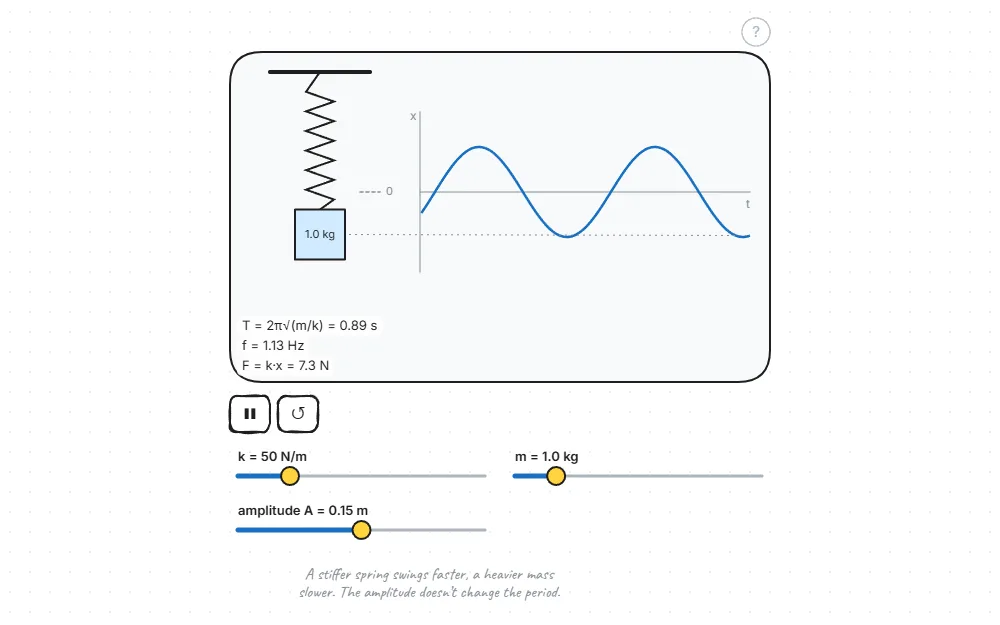
Pull the mass away from its resting point and let go: the restoring force makes it swing back and forth around that point. This is simple harmonic motion, and its position over time traces a sine curve.
The period depends only on the mass and the spring constant. A stiff spring bounces quickly, a heavy mass slowly. The amplitude, how far you pull it, doesn’t change the period.
The formula
T = 2π √(m / k) · F = k x
- T: period, s
- m: mass, kg
- k: spring constant, N/m
- x: distance from the resting point, m
Things to try
- Start with k = 50 N/m and m = 1 kg. The period is about 0.89 s.
- Make the mass four times bigger, from 1 to 4 kg. The period doubles to about 1.78 s.
- Set the spring constant to 200 N/m. The spring is stiffer and the mass bounces faster; the period is shorter.
- Raise the amplitude from 0.05 m to 0.25 m. The mass goes further, but the period stays the same.
Questions and answers
A 1 kg mass hangs on a spring with k = 100 N/m. What is the period?
T = 2π√(1/100) = 6.28 × 0.1 ≈ 0.63 s.
Keeping the mass the same, what spring constant halves the period?
Four times the original; the period goes with √(1/k).
Would a mass on a spring have a different period on the Moon?
No. There is no g in the formula; gravity only moves the resting point.
For teachers
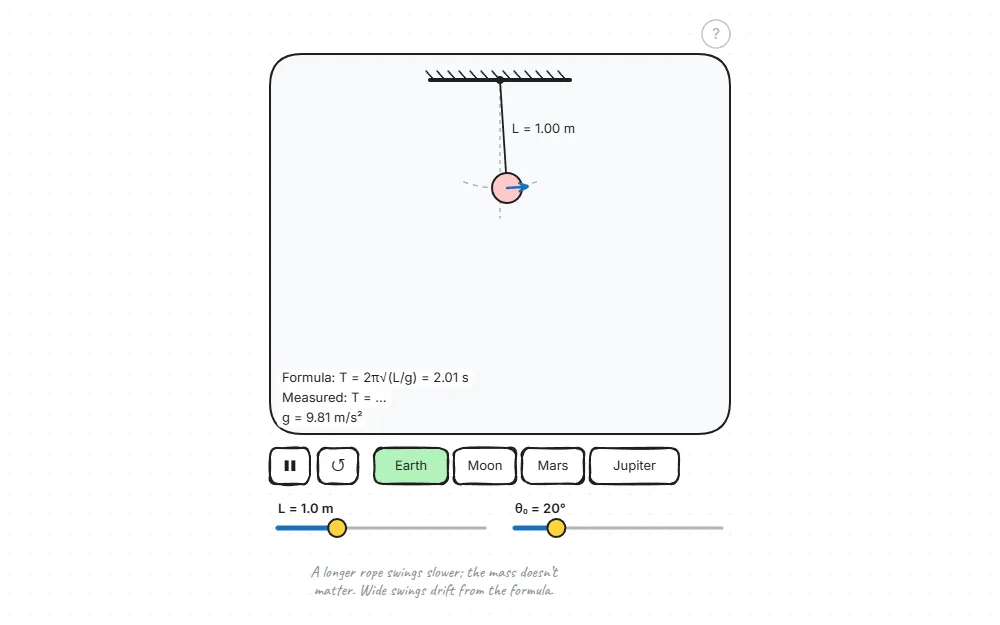
- Compare with the simple pendulum: one period depends on g and the other doesn’t. Why?
- Time the period for several masses and find the spring constant from a graph of T² against m.