WebPad
What’s going on
Planets go round the Sun because of its gravity. Launched at the right speed, an object keeps moving forward and falling at the same time, so it circles the star for ever.
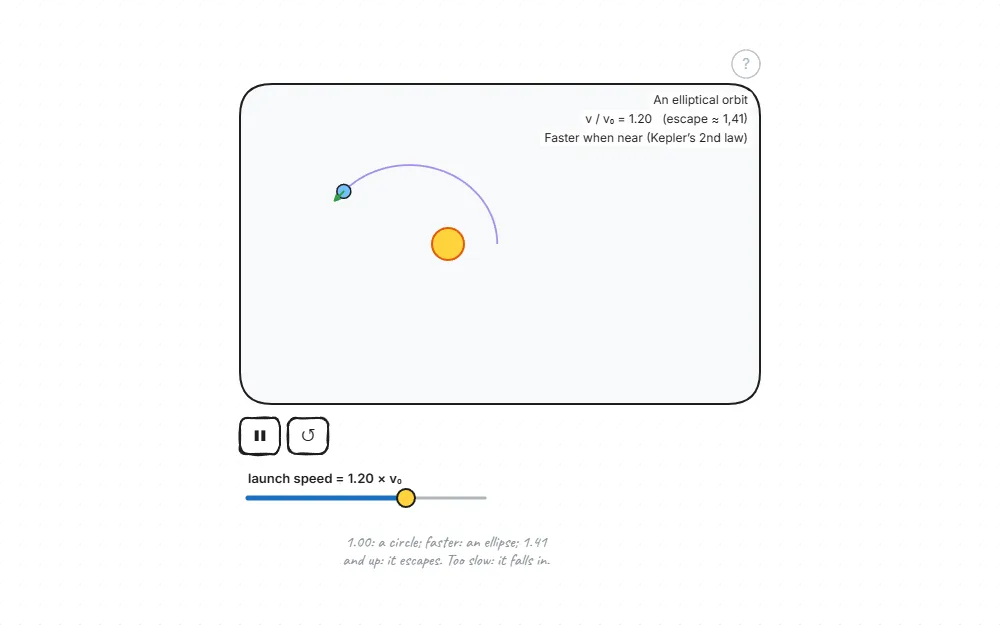
Kepler’s first law says orbits are ellipses with the Sun at one focus. His second says the line from the Sun to the planet sweeps out equal areas in equal times, so a planet moves fast when it is close to the Sun and slowly when it is far away.
In the simulation the speed is given as a multiple of the circular-orbit speed. 1 gives a perfect circle. A little faster gives an ellipse. At about 1.41 times (√2) the planet escapes: that is the escape velocity. Too slow and it falls into the star.
The formula
v_circle = √(G M / r) · v_escape = √2 × v_circle
- G: gravitational constant
- M: mass of the star
- r: distance from the star
Things to try
- Set the speed to 1.00. The planet traces a circle and its speed never changes.
- Set it to 1.20 (the default). The orbit becomes an ellipse; the planet speeds up near the star and slows down far from it.
- Go above 1.41. The planet doesn’t come back: it escapes.
- Drop the speed to 0.40. The planet falls into the star.
Questions and answers
The Earth is closest to the Sun in January. Is it moving faster then?
Yes. By Kepler’s second law it moves faster when it is nearer the Sun.
A satellite’s circular orbit speed is 7.9 km/s. Roughly what is its escape velocity?
v_escape = √2 × 7.9 ≈ 11.2 km/s.
Why do astronauts on the space station seem weightless?
The station and the astronauts are always falling towards the Earth, but their sideways speed carries them round it. Falling together, they feel weightless.
For teachers
- Swing an eraser on a string to show the pull towards the centre, then replace the string with gravity.
- Link it to the dates when the Earth is nearest to and furthest from the Sun.