WebPad
What’s going on
A lever is a stiff bar that can turn about a pivot. See-saws, scissors, wheelbarrows and pliers are all levers.
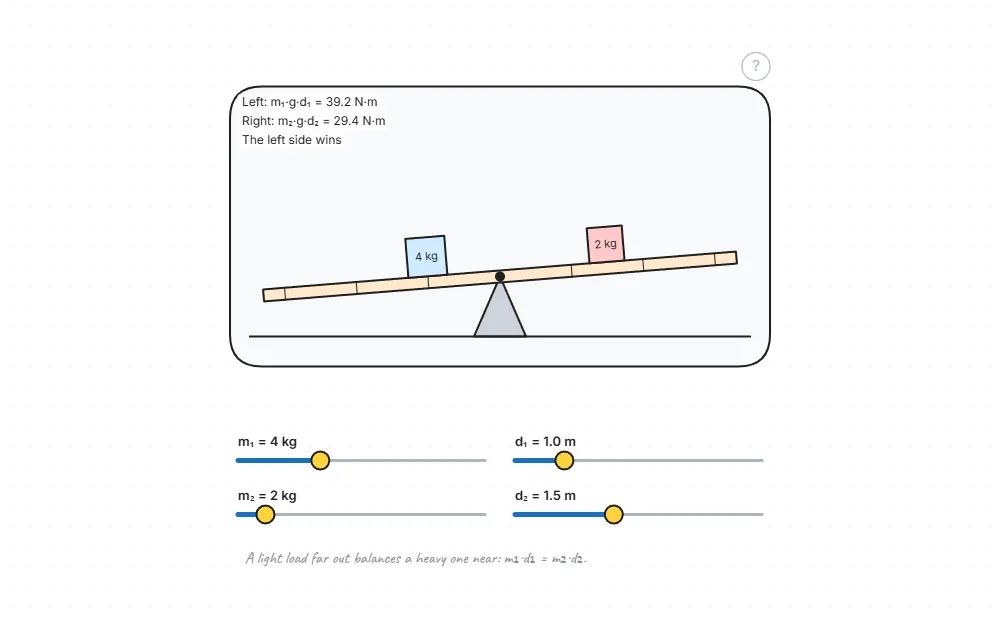
The turning effect of a force is its moment, or torque: the force times its distance from the pivot. When the moments on both sides are equal, the lever balances.
That is why a small child at the end of a see-saw can balance an adult sitting near the middle. The line credited to Archimedes, “Give me a place to stand and I will move the Earth”, comes from the same idea.
The formula
m₁ × d₁ = m₂ × d₂
- m₁, m₂: masses on each side, kg
- d₁, d₂: distances from the pivot, m
Things to try
- Look at the default values (4 kg at 1 m, 2 kg at 1.5 m). The left side goes down: 4 × 1 = 4, 2 × 1.5 = 3.
- Set d₂ to 2 m. The see-saw balances: 2 × 2 = 4.
- Set m₁ to 6 kg and find the balance again. With m₂ = 2 kg you need d₂ = 3 m: 6 × 1 = 2 × 3.
Questions and answers
A 30 kg child sits 2 m from the pivot. Where must a 60 kg adult sit to balance?
30 × 2 = 60 × d, so d = 1 m.
Why is it easier to undo a bolt with a long spanner?
A longer handle turns the same force into a bigger moment, so less force is needed to turn the bolt.
What class of lever is a pair of scissors?
A first-class lever, with the pivot (the screw) in the middle; a see-saw is one too.
For teachers
- Build a small see-saw from a ruler, a pencil and coins and compare the results with the simulation.
- Ask students to find levers at home (door handles, wheelbarrows, tweezers) and mark the pivot.