WebPad
What’s going on
A converging (convex) lens brings parallel rays together at its focal point. A diverging (concave) lens spreads them out; their extensions meet at the focal point.
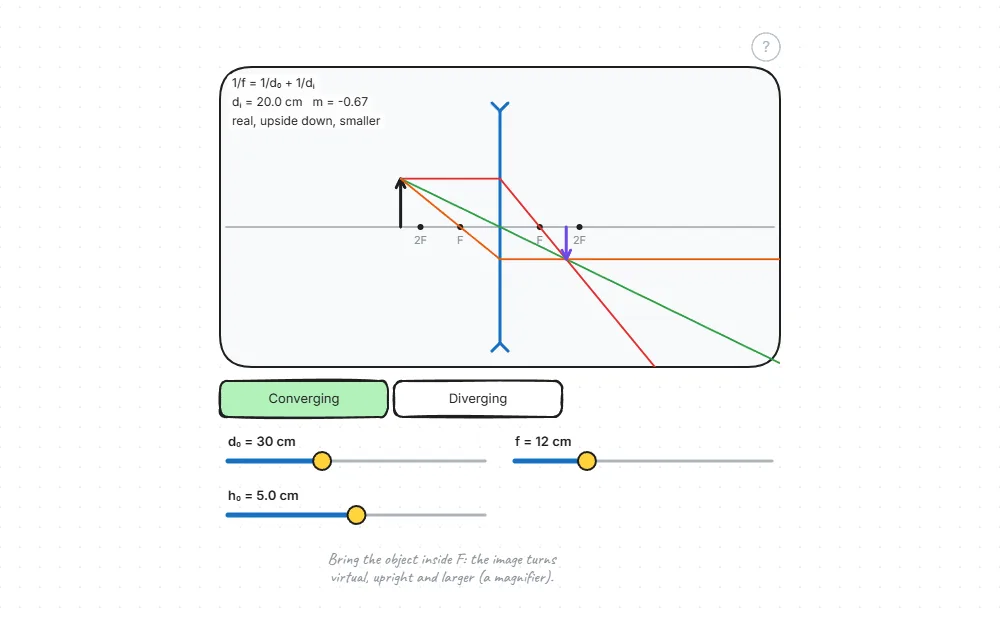
With a converging lens the image depends on where the object is. Outside the focal point the image is upside down and real: you can catch it on a screen. At twice the focal length the image is the same size. Inside the focal point the image becomes upright, larger and virtual; that is a magnifying glass.
A diverging lens always gives an upright, smaller, virtual image. Glasses for short sight use diverging lenses; glasses for long sight and magnifiers use converging ones.
The formula
1/f = 1/d₀ + 1/dᵢ · magnification = −dᵢ / d₀
- f: focal length
- d₀: distance from the object to the lens
- dᵢ: distance from the image to the lens (negative: virtual)
Things to try
- With the converging lens, set f = 12 cm and d₀ = 30 cm. The image is upside down, smaller and real, about 20 cm from the lens.
- Set d₀ to 24 cm (2f). The image is the same size and upside down, also 24 cm away.
- Set d₀ to 8 cm (inside the focal point). The image is upright, larger and virtual: a magnifier.
- Switch to “Diverging” and move the object. Wherever it is, the image stays upright, smaller and virtual.
Questions and answers
An object is 30 cm from a converging lens with a focal length of 10 cm. Where is the image?
1/dᵢ = 1/10 − 1/30 = 2/30, so dᵢ = 15 cm. It is upside down, real and half the size.
Why do you hold a magnifying glass close to what you are looking at?
Inside the focal length, a converging lens gives an upright, larger, virtual image.
Why do glasses for short sight use diverging lenses?
In a short-sighted eye the image forms in front of the retina. A diverging lens spreads the rays a little and moves the image back onto it.
For teachers
- Use a magnifying glass to throw an upside-down image of the window onto paper, then compare with the simulation.
- Have students record the image’s properties for five object positions in a table.