WebPad
What’s going on
Pascal’s law says that pressure applied to a liquid in a closed container is passed on unchanged to every part of the liquid.
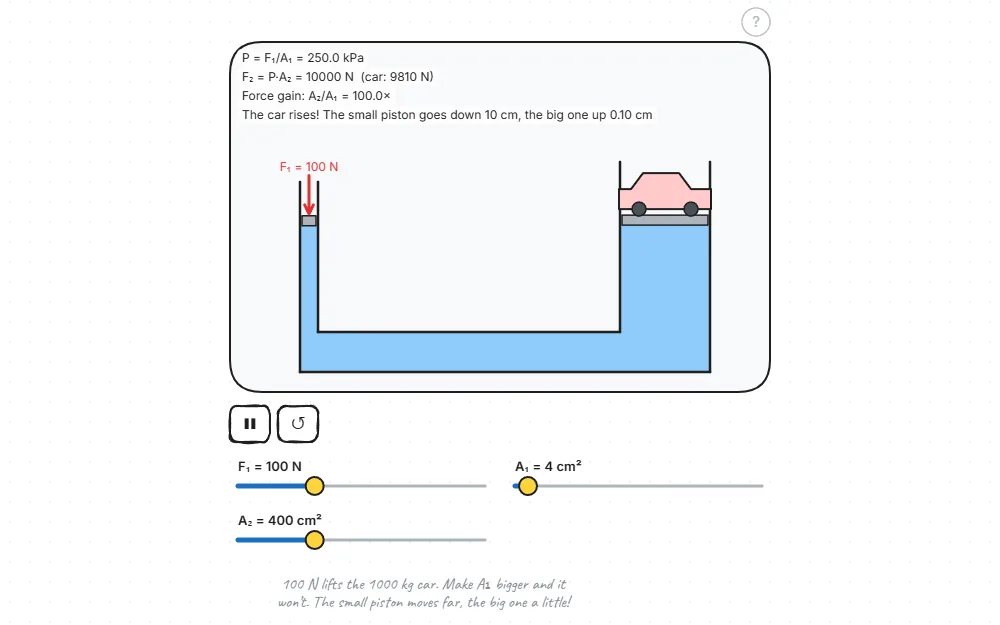
In a hydraulic press, two pistons share the same liquid. A force on the small piston creates a pressure; that same pressure acting on the big piston’s larger area gives a much bigger force. If the big piston has a hundred times the area, the force is a hundred times bigger.
There is a catch: the big piston rises only a hundredth of the distance the small one moves down. The work (force × distance) is the same on both sides. Garage car lifts, diggers and car brakes all use this.
The formula
F₁ / A₁ = F₂ / A₂
- F₁, F₂: forces on the small and big pistons, N
- A₁, A₂: areas of the pistons, cm²
Things to try
- Look at the default values (100 N, 4 cm², 400 cm²). The big piston gets 10 000 N and lifts the car, which weighs about 9800 N.
- Make A₁ bigger, from 4 to 8 cm². The force on the big piston halves and the car stays down.
- With A₁ = 8 cm², set F₁ to 200 N. The car rises again: the pressure is back to what it was.
- Watch how the pistons move. The small piston moves a long way down; the big one rises only a little.
Questions and answers
The small piston is 5 cm² and the big one 500 cm². What force does 50 N on the small piston give?
F₂ = F₁ × A₂ ÷ A₁ = 50 × 500 ÷ 5 = 5000 N.
If the small piston moves down 20 cm, how far does the big one rise?
The volume is the same: 5 × 20 = 500 × h, so h = 0.2 cm.
Does a hydraulic press make energy?
No. It multiplies the force but divides the distance by the same amount; the work done is the same on both sides.
For teachers
- Join two different syringes with a tube and let students push them against each other to feel the difference.
- Use Pascal’s law to explain a diagram of a car’s braking system.