WebPad
What’s going on
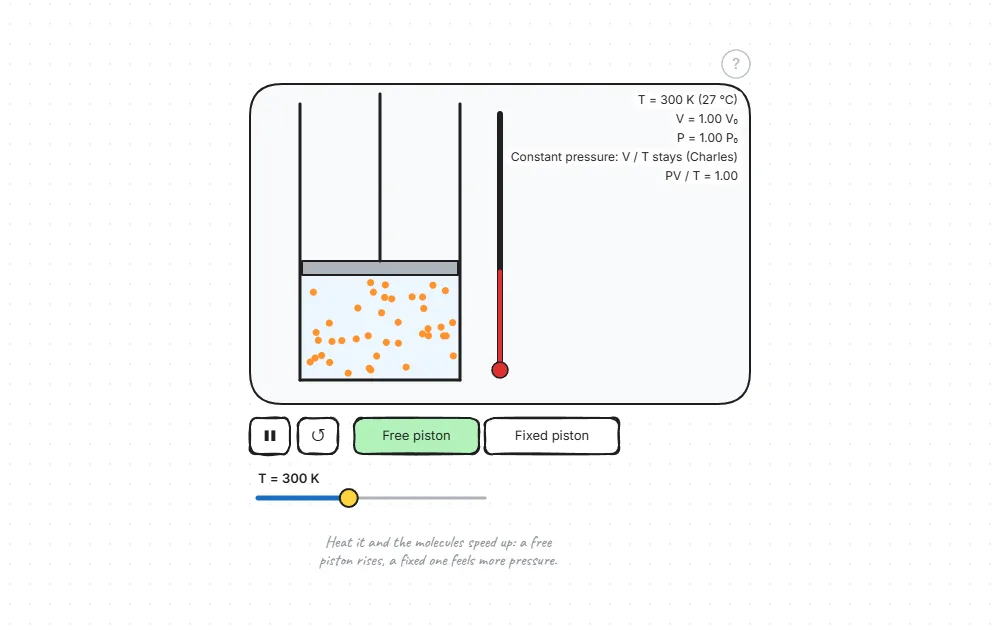
A gas is made of particles moving constantly and at random. Their hits on the container’s walls make the pressure. Warm the gas and the particles move faster, hitting the walls more often and harder.
With a free piston, a warming gas pushes the piston up and expands: the pressure stays the same while the volume grows in proportion to the absolute temperature. That is Charles’s law.
With a fixed piston the gas can’t expand, so the pressure grows in proportion to the absolute temperature instead. That is Gay-Lussac’s law. In these laws temperature is always in kelvin: K = °C + 273.
The formula
P V / T = constant · V₁/T₁ = V₂/T₂ · P₁/T₁ = P₂/T₂
- P: pressure
- V: volume
- T: absolute temperature, kelvin (K)
Things to try
- With “Free piston”, raise the temperature from 300 K to 600 K. The particles speed up, the piston rises and the volume doubles.
- Switch to “Fixed piston” and double the temperature again. The volume stays put and the pressure doubles.
- Lower the temperature to 100 K. The particles slow right down; with a free piston the volume shrinks.
Questions and answers
At constant pressure, 2 L of gas is warmed from 300 K to 450 K. What is its new volume?
V₂ = V₁ × T₂ ÷ T₁ = 2 × 450 ÷ 300 = 3 L.
Why is temperature in kelvin in the gas laws?
Volume and pressure are proportional to absolute temperature. 0 °C isn’t where particle motion stops; 0 K, absolute zero, is.
Why does tyre pressure go up in summer?
A tyre’s volume hardly changes, so when the air inside warms up its pressure rises (Gay-Lussac).
For teachers
- Show Charles’s law with a balloon on a bottle dipped in hot water and then in iced water.
- A good step before the ideal gas equation in chemistry.