WebPad
What’s going on
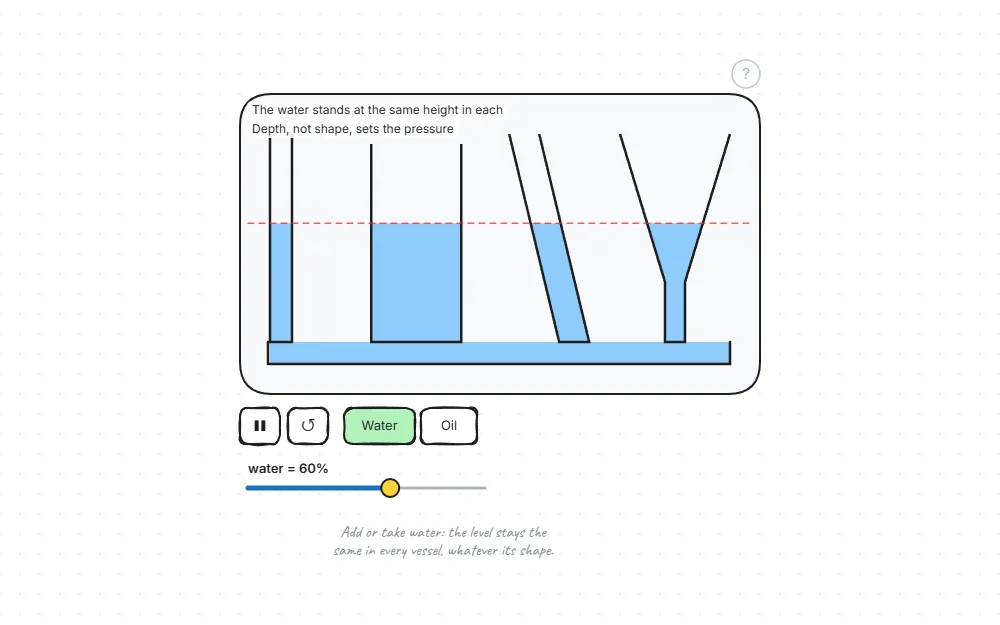
Vessels joined at their bases are called communicating vessels. A liquid poured into them rises to the same height in all of them, whatever their shape or width.
The reason is liquid pressure. At any point in the connecting pipe the pressure from each side has to match, and since pressure depends only on depth, the surfaces settle at the same height.
Teapot spouts, water levels used by builders, town water towers and toilet cisterns all work this way. If a teapot’s spout were lower than its body, the tea would spill out of it.
Things to try
- Raise the water from 60% to 90%. The level rises in every vessel at once and stays equal.
- Lower it to 20%. The level falls together everywhere.
- Switch the liquid to “Oil”. The levels are still equal; as long as there is one liquid, the rule holds.
Questions and answers
Why does the liquid stand at the same level in every vessel?
The pressures in the connection at the bottom must be equal. Liquid pressure depends only on depth, so the surfaces end up at the same height.
Why is a teapot’s spout as high as the top of its body?
The spout and the body are communicating vessels. A lower spout would spill tea before the pot was full.
Why are water towers built on high ground?
Water in connected pipes tries to rise to the tank’s level. A high tank means the water reaches taps in homes with enough pressure.
For teachers
- Join two plastic bottles at the bottom with a tube and raise and lower one in front of the class.
- Use it to explain how builders use a water level to mark the same height on two walls.