WebPad
What’s going on
Anything put into a liquid feels an upward push from it. The push equals the weight of the liquid the object moves out of the way. That is Archimedes’ principle, the one he is said to have noticed in the bath.
Whether something floats comes down to comparing densities. If the object is less dense than the liquid it floats, if it is just as dense it hangs in the liquid, and if it is denser it sinks. How much of a floating object sits under the surface depends on the same ratio.
Salt water is denser than fresh water, which is why people float so easily in the Dead Sea. Mercury is so dense that even iron floats on it.
The formula
F_b = ρ(liquid) × g × V(submerged)
- F_b: buoyant force, in newtons (N)
- ρ(liquid): density of the liquid, kg/m³ (water: 1000)
- V(submerged): volume of the object under the surface, m³
Things to try
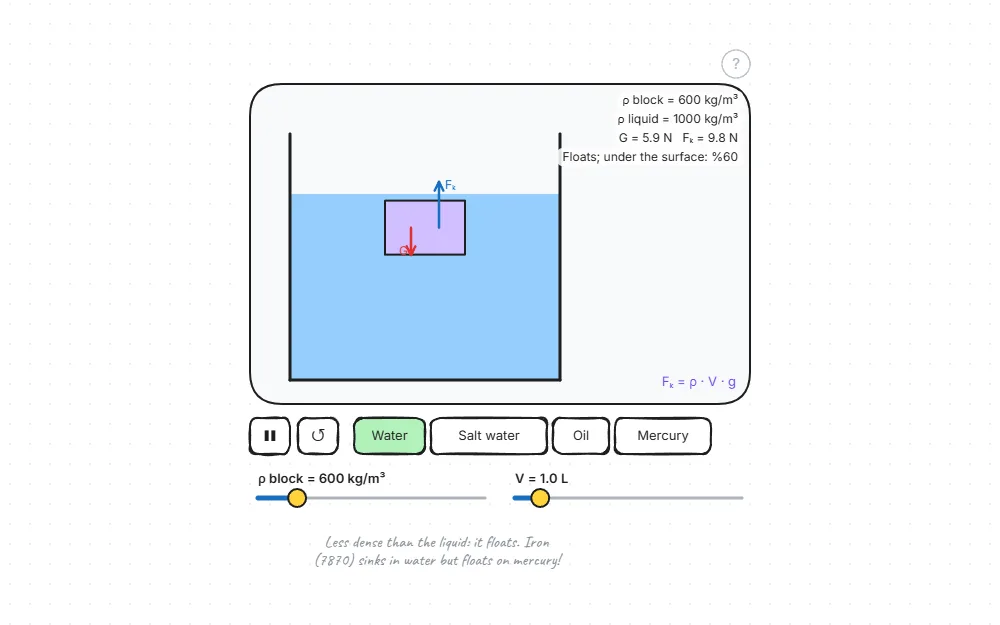
- Leave the block at 600 kg/m³ in water. It floats with about 60% of it under water.
- Slowly raise the density to 950. It sits lower and lower; at 950 it is almost all under water.
- Set it to 1200 kg/m³. It sinks: even fully under, its weight is more than the buoyant force.
- Set 1000: it sinks. Now switch to “Salt water”. Salt water (1030) is denser than the block, so the same block floats.
- Set 950 and switch to “Oil”. The block that floated in water sinks in oil; oil (920) is less dense than water.
Questions and answers
A 2 L object is fully under water. What is the buoyant force? (g = 10 m/s²)
V = 2 L = 0.002 m³. F = 1000 × 10 × 0.002 = 20 N.
Wood with a density of 800 kg/m³ floats in water. How much of it is under the surface?
800 ÷ 1000 = 0.8, so about 80%.
Why don’t steel ships sink?
A ship is hollow; with the air inside, its average density is less than water’s. It also pushes aside a huge volume of water, so the buoyant force can carry its weight.
An egg sinks in fresh water but floats in salt water. Why?
The egg is a little denser than fresh water but less dense than salt water. Salt raises the water’s density, so the buoyant force gets bigger.
For teachers
- Pair it with the egg and salt water demo in class; the simulation then explains it with numbers.
- Ask students to find the range of densities that float in water but sink in oil.