WebPad
What’s going on
A fuse is a safety part that melts and breaks the circuit when the current goes over a set value. It stops wires from overheating and starting a fire.
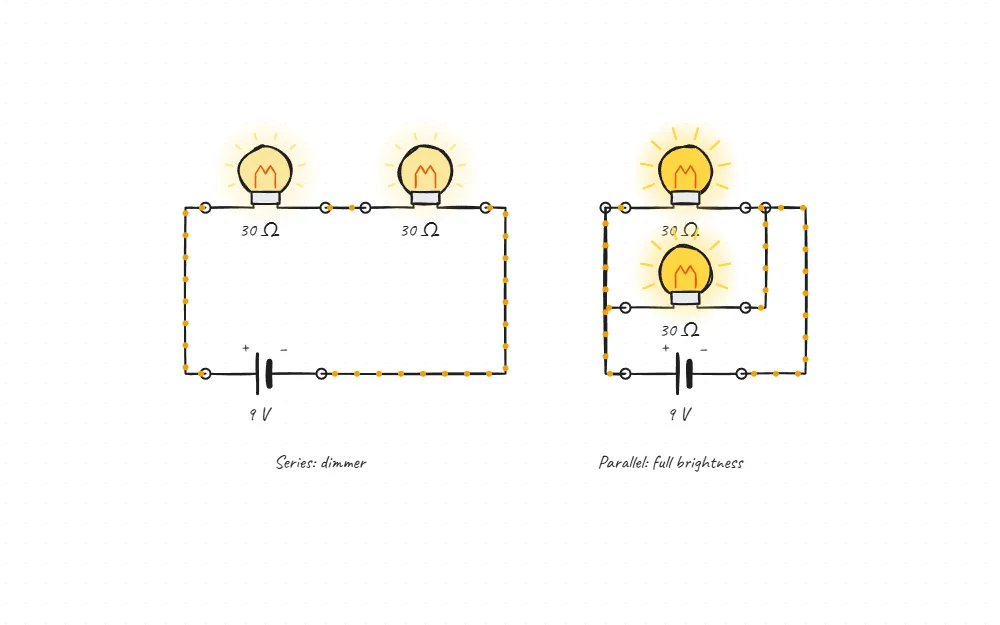
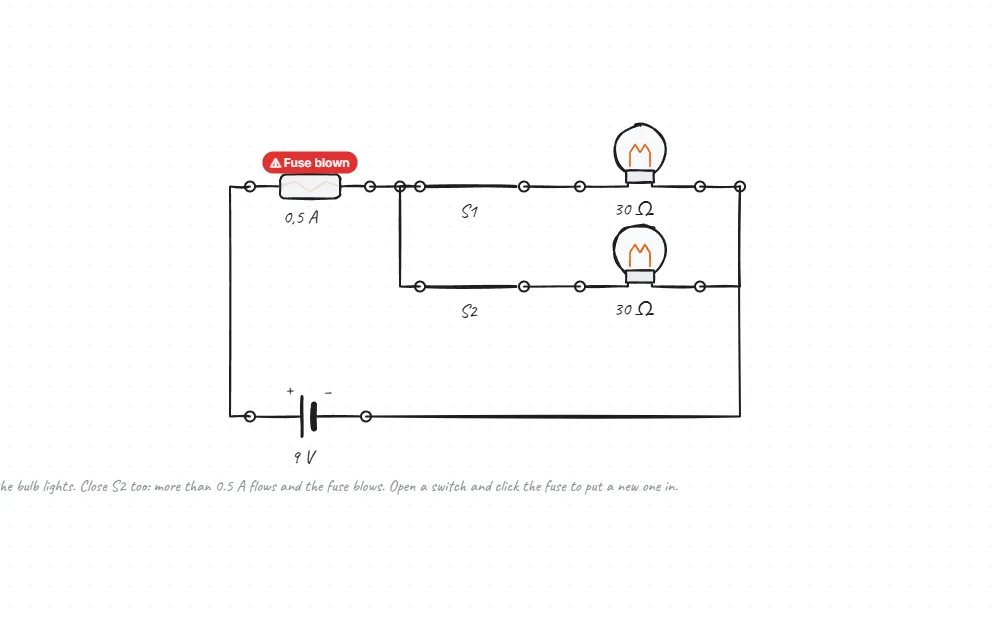
Every extra device in parallel draws more current from the battery or the mains. Here one 30 Ω bulb draws about 0.3 A; two together draw close to 0.6 A, more than the 0.5 A fuse allows.
That is also why a fuse trips at home when a heater, an iron and a kettle share one socket. Most homes now use circuit breakers that can be reset instead of fuses that are replaced.
The formula
I_total = I₁ + I₂ · I = V / R
- I_total: sum of the currents in the parallel branches: the current through the fuse
- V: battery voltage, 9 V
- R: resistance of one bulb, 30 Ω
Things to try
- Close only S1. The bulb lights; about 0.3 A flows through the fuse.
- Close S2 as well. The current passes 0.5 A and the fuse blows; both bulbs go out.
- Open one switch and click the fuse. A new fuse goes in and one bulb lights again.
- Double-click the fuse, make it 1 A and close both switches. This time the fuse holds and both bulbs light.
Questions and answers
Two 30 Ω bulbs in parallel on a 9 V battery: how much current do they draw in total?
Each draws 9 ÷ 30 = 0.3 A, so 0.6 A in total.
Why is a fuse connected in series?
All the current has to pass through it; only then can it cut the whole circuit when the limit is passed.
Why is it dangerous to replace a blown fuse with a bigger one?
The wires were chosen for the original current. A bigger fuse may not blow even while the wires overheat, which can start a fire.
For teachers
- Start with a photo of a fuse box or consumer unit and ask “Why is this here?”.
- Ask students to add a third bulb and work out which fuse rating would be enough.