WebPad
What’s going on
A capacitor stores electric charge for a short while. Inside are two conducting plates that don’t touch; connect it to a battery and opposite charges build up on them.
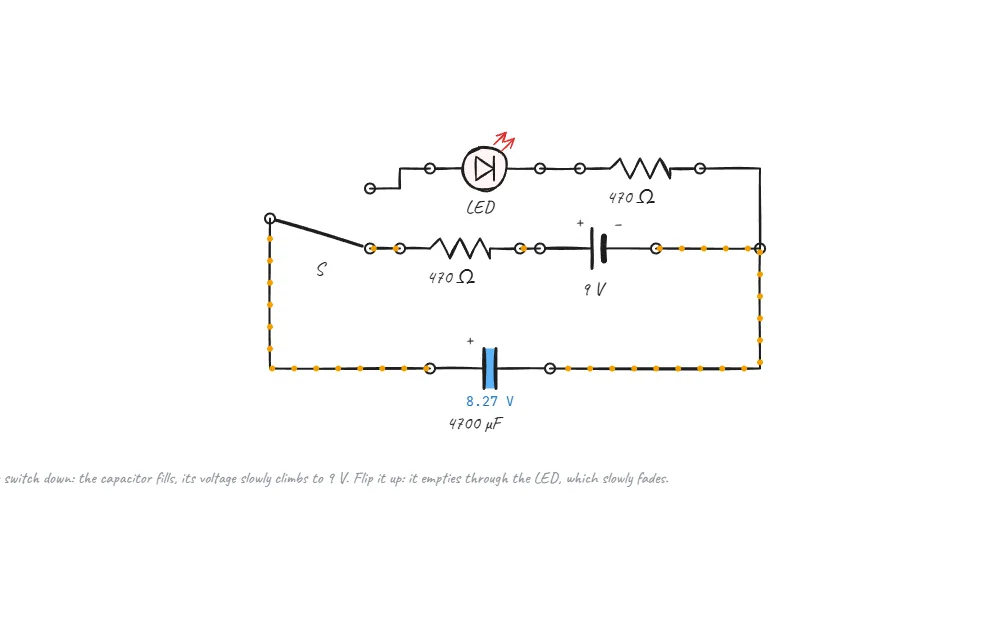
Charged through a resistor, a capacitor doesn’t fill at once. It charges along a curve, quickly at first and then more and more slowly. How fast is set by the resistance times the capacitance: the time constant RC. With 470 Ω and 4700 µF it is about 2.2 seconds.
Discharging works the same way: the current is large at first and shrinks as the capacitor’s voltage drops. That is why the LED fades rather than switching off. A camera flash stores energy in a capacitor and lets it all go at once.
The formula
τ = R × C
- τ: time constant, s (in this time the capacitor charges to about 63%)
- R: resistance, Ω
- C: capacitance, farads (F); 4700 µF = 0.0047 F
Things to try
- Flip the switch down. The capacitor’s voltage climbs towards 9 V; quickly at first, then slowly.
- When it is close to 9 V, flip the switch up. The LED lights and fades away over a few seconds.
- Double-click the capacitor, make it 1000 µF and try again. Charging and discharging are much quicker; the LED goes out almost at once.
- Change the charging resistor from 470 Ω to 1 kΩ. The capacitor charges more slowly: the time constant is bigger.
Questions and answers
What is the time constant of a 1 kΩ resistor with a 1000 µF capacitor?
τ = R × C = 1000 × 0.001 = 1 s.
Why doesn’t a capacitor charge instantly?
As its voltage gets closer to the battery’s, the voltage across the resistor, and so the current, gets smaller. Less current means slower charging.
Does current keep flowing once a capacitor is fully charged?
Not in a DC circuit. There is an insulator between the plates, so the current stops once it is charged.
For teachers
- Have students read the voltage at a few moments while it charges and plot it against time; the shape of the curve starts a good discussion.
- Pair it with the oscilloscope experiment to see the same curve drawn on screen.