WebPad
What’s going on
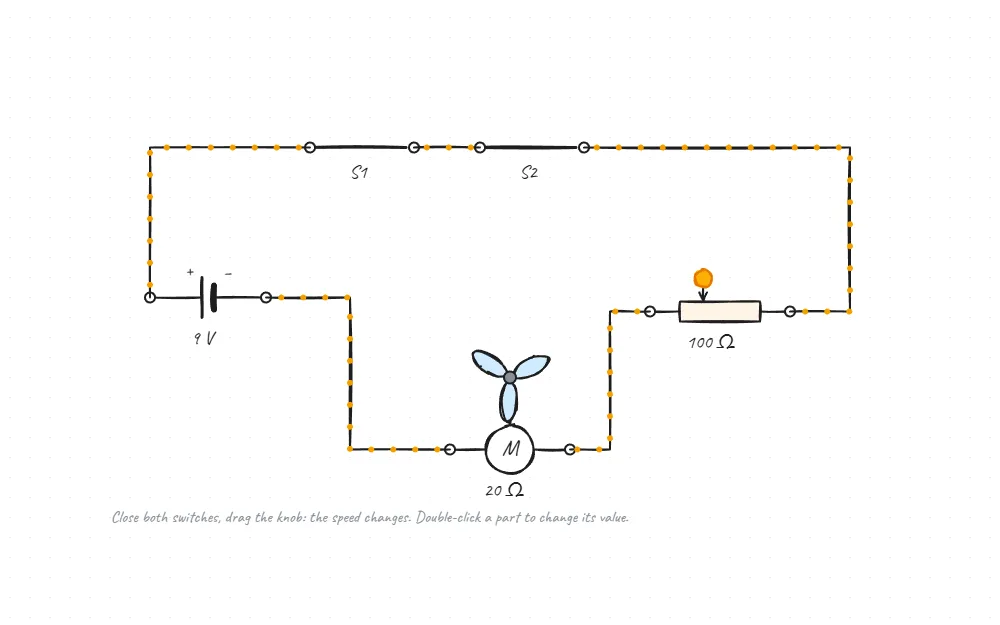
A potentiometer is a resistor whose resistance changes as you turn its knob. Here it is in series with the motor, so the more resistance it adds, the less current flows.
A motor’s speed follows the current through it: less current, slower; more current, faster. The speed knobs on old fans and toy cars work on the same idea.
The two switches are in series, so both have to be closed for the motor to run. Open either one and the path is broken. It is the electrical version of a logical AND.
The formula
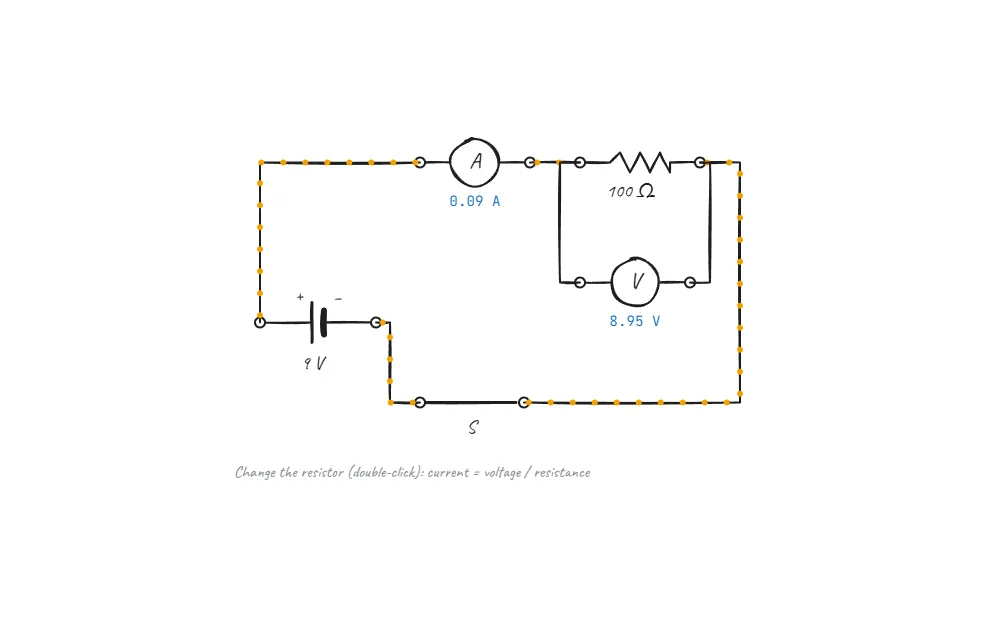
I = V / (R_motor + R_pot)
- I: current in the circuit, A
- V: battery voltage, V
- R_pot: the potentiometer’s resistance at that moment, Ω
Things to try
- Close only S1. The fan doesn’t turn: S2 is open, so the path is broken.
- Close S2 as well. The fan starts turning.
- Drag the potentiometer’s knob from one end to the other. Less resistance, faster fan; more resistance, slower.
- Double-click the battery and lower its voltage. At the same knob position the fan turns more slowly.
Questions and answers
What happens to the current when the potentiometer’s resistance goes up?
It goes down. The total resistance is bigger and the voltage is the same, so I = V / R is smaller.
Why doesn’t the motor run when one of the two series switches is open?
A series circuit has only one path. Open it anywhere and no current can flow anywhere.
Where are potentiometers used?
Volume knobs, light dimmers, joysticks and the tuning dials of old radios, for example.
For teachers
- Have students wire the switches in parallel instead and ask what changes: now either one turns the motor on (OR).
- Add an ammeter and have them record the current at a few knob positions in a table.