WebPad
What’s going on
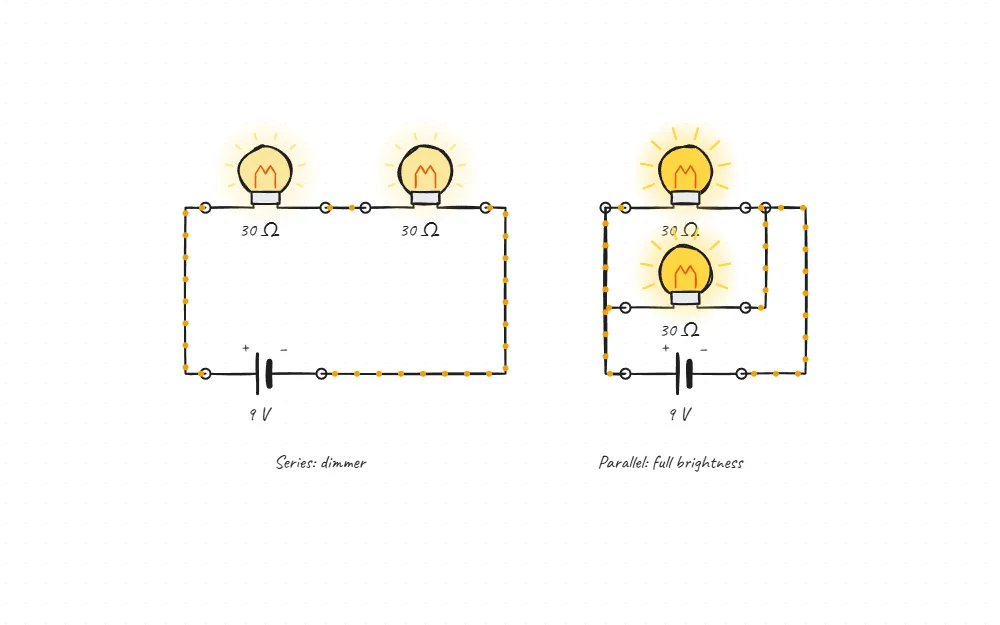
In a series circuit the bulbs sit one after another on a single path. The same current flows through both, and the battery’s voltage is shared between them. Two identical bulbs get half the voltage each, so they glow dim.
In a parallel circuit each bulb has its own path back to the battery. Each one gets the full voltage and glows as brightly as it would on its own. The catch: the battery has to supply more current in total, so it runs down faster.
The lights and sockets in a house are wired in parallel, which is why switching one lamp off leaves the rest on. Old Christmas lights were wired in series: one dead bulb and the whole string went dark.
The formula
Series: R = R₁ + R₂ · Parallel: 1/R = 1/R₁ + 1/R₂
- R: total (equivalent) resistance, in ohms
- R₁, R₂: resistance of each bulb
Things to try
- Open the experiment and compare the two circuits. The series bulbs are clearly dimmer than the parallel ones.
- Delete one wire in the series circuit. The path is broken, so both bulbs go out.
- Delete the wire to one bulb in the parallel circuit. The other bulb keeps glowing just as brightly.
- Add a third bulb to the series circuit. The voltage is split three ways and all three get dimmer.
- Take an ammeter from the library and put it next to each battery. The parallel circuit draws about four times the current of the series one.
Questions and answers
Two 30 Ω bulbs are connected in series. What is the total resistance?
R = 30 + 30 = 60 Ω.
The same two bulbs are connected in parallel. What is the total resistance?
1/R = 1/30 + 1/30 = 2/30, so R = 15 Ω. Two equal resistors in parallel give half of one.
Why are the lights in a house wired in parallel?
So each lamp gets the full mains voltage, and switching one off or losing one doesn’t turn the others off.
If parallel bulbs are brighter, why isn’t everything wired in parallel?
A parallel circuit draws more current, so a battery runs down faster. And some parts must carry all the current: fuses and switches go in series for that reason.
For teachers
- Before opening it, ask: “Which pair of bulbs will be brighter?” Many students expect them to be the same.
- Deleting and redrawing a wire is a safe stand-in for unscrewing a bulb: students can break the circuit and build it again.