WebPad
What’s going on
The voltage across a conductor is proportional to the current through it. The ratio stays the same, and that ratio is the resistance. Georg Ohm measured this in 1827, and it has been taught as Ohm’s law ever since.
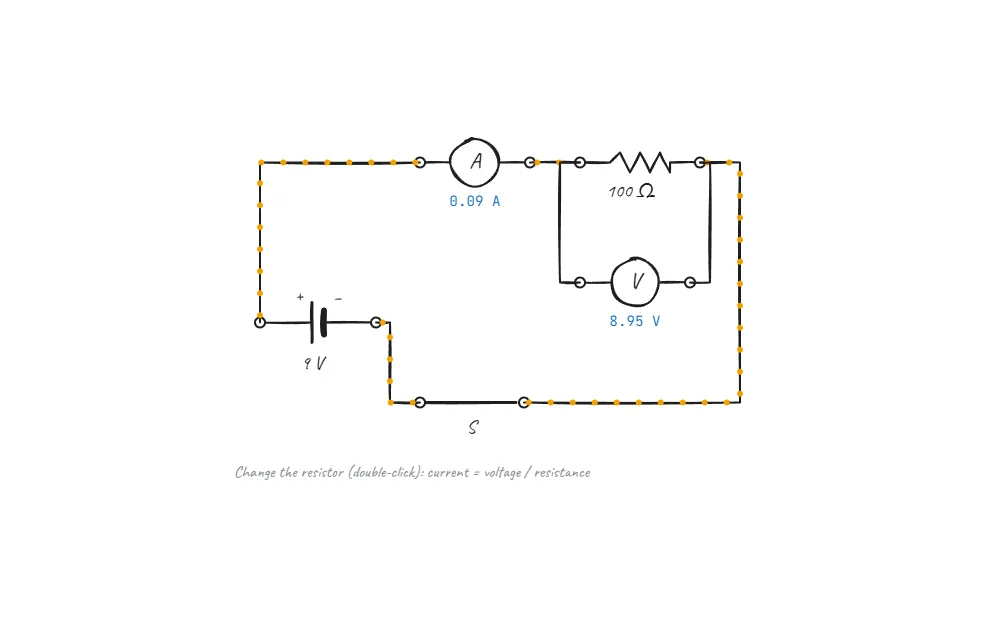
In this circuit a 9 volt battery drives a 100 ohm resistor. The ammeter sits in series with the resistor, so the same current flows through both. The voltmeter is connected in parallel across the resistor and reads the voltage across it.
Make the resistance bigger and the voltage stays about the same while the current drops. Halve the resistance and the current doubles. Divide any voltage reading by its current and you get the resistance back.
The formula
V = I × R
- V: voltage, in volts (V)
- I: current, in amps (A)
- R: resistance, in ohms (Ω)
Things to try
- Click the switch to close the circuit. The ammeter reads about 0.09 A and the voltmeter close to 9 V: 9 ÷ 100 ≈ 0.09.
- Double-click the resistor and make it 200 Ω. The current halves to about 0.045 A. The voltage stays put.
- Make the resistor 50 Ω. The current doubles to about 0.18 A.
- Double-click the battery and set it to 4.5 V. With the same resistor the current halves too: voltage and current move together.
- Write your readings into a table on the same page and plot current against voltage. The points line up on a straight line through the origin; the slope gives 1 / R.
Questions and answers
A 60 Ω resistor is connected to a 12 V battery. What current flows?
I = V ÷ R = 12 ÷ 60 = 0.2 A.
A resistor carries 0.5 A with 10 V across it. What is its resistance?
R = V ÷ I = 10 ÷ 0.5 = 20 Ω.
If the resistance stays the same and the voltage doubles, what happens to the current?
It doubles too. Current is proportional to voltage for a fixed resistance.
Why does an ammeter go in series and a voltmeter in parallel?
An ammeter measures the current flowing through it, so it has to sit in the current’s path. A voltmeter measures the difference between two points, so it connects across them.
Does Ohm’s law work for every component?
No. It holds for metal wires and resistors at a steady temperature. A bulb’s filament gets more resistant as it heats up, and in diodes and LEDs the current is not proportional to the voltage.
For teachers
- Ask for a prediction first: “What happens to the current if we double the resistance?” Then let students try it.
- They can build the results table and the graph next to the circuit on the same page, and you can share the page as a link.