WebPad
What’s going on
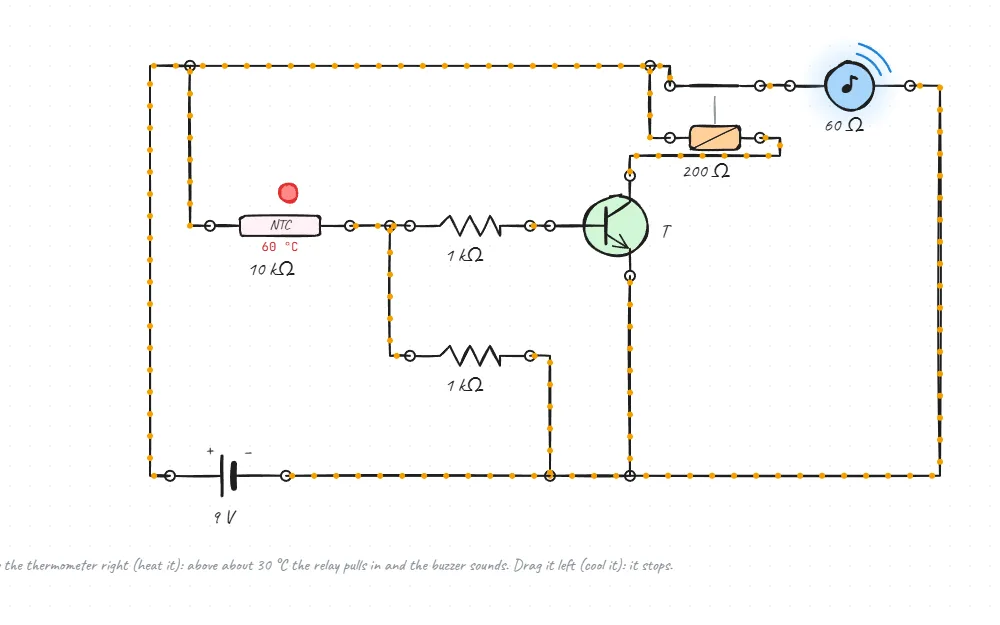
A thermistor is a resistor whose resistance changes with temperature. The NTC type in this circuit gets less resistant as it warms up.
The thermistor and a 1 kΩ resistor form a voltage divider. As it gets warmer and the thermistor’s resistance falls, the voltage at the transistor’s base rises and the transistor starts to conduct.
The transistor doesn’t drive the buzzer directly but a relay: an electromagnetic switch worked by a small current. When it closes it feeds the buzzer through a separate path, so a small sensor circuit can switch large loads. Fire alarms and boiler thermostats work in a similar way.
Things to try
- Slowly drag the thermometer to the right. Above about 30 °C the relay pulls in and the buzzer sounds (you hear it with sound on).
- Drag the thermometer to the left. The thermistor’s resistance rises, the transistor stops conducting, the relay lets go and the buzzer stops.
- Change the lower 1 kΩ resistor to 2 kΩ. The alarm goes off at a different temperature: the threshold has moved.
- Put a bulb in place of the buzzer. The same circuit now turns on a light when it gets warm.
Questions and answers
How does an NTC thermistor’s resistance change as it gets warmer?
It goes down. NTC stands for “negative temperature coefficient”.
Why use a relay instead of driving the buzzer straight from the transistor?
A relay keeps the sensor circuit separate from the buzzer or motor circuit, and lets a small current switch much larger currents, even mains voltage.
What could be changed so the alarm goes off at a higher temperature?
The resistor in the voltage divider; that moves the temperature at which the transistor starts to conduct.
For teachers
- Ask students how to turn it into a “freezer alarm” that sounds when it gets cold.
- Compare the relay with an ordinary switch to link it to electromagnets.