WebPad
What’s going on
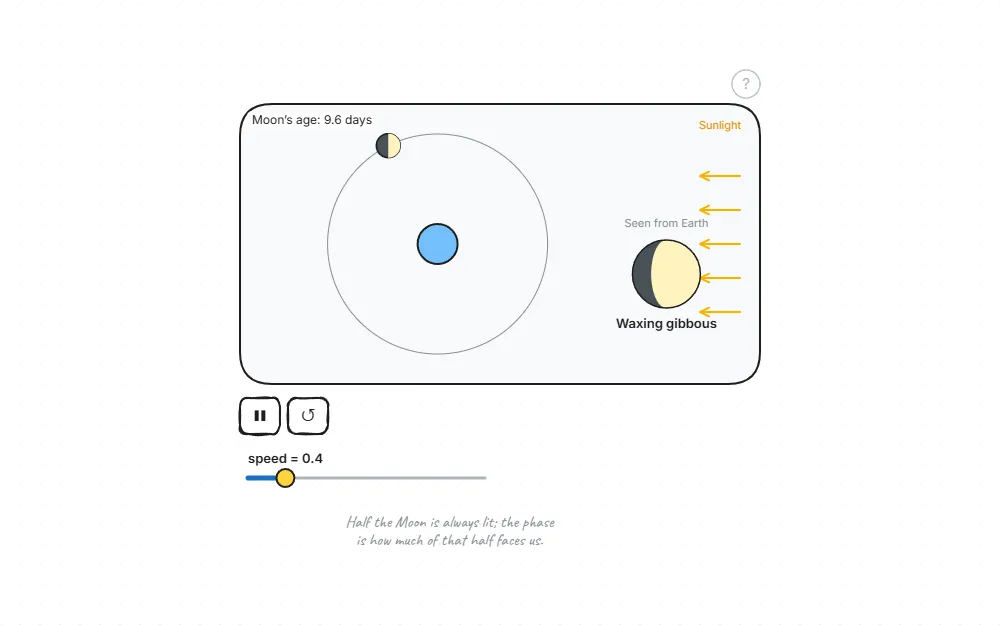
The Moon makes no light of its own; it reflects sunlight. At any moment the half facing the Sun is lit and the other half is dark.
The Moon goes round the Earth about once every 29.5 days. As it does, the amount of its lit half we can see from Earth changes. That is what makes the phases, not the Earth’s shadow.
When the Moon is between the Sun and the Earth, its lit side faces away from us: a new moon. When it is on the far side of the Earth we see all of its lit side: a full moon. In between come the crescents, the quarters and the gibbous moons.
Things to try
- Start the simulation and watch one full orbit. The shape on the right goes from new moon to full moon and back to new moon.
- Stop it when the Moon is between the Sun and the Earth. No Moon can be seen from Earth: a new moon.
- Stop it a quarter of an orbit later. Half of the Moon looks lit: the first quarter.
- Slow it down and watch the phases after the full moon. The lit part now shrinks from the other side: the last quarter and a waning crescent.
Questions and answers
What causes the phases of the Moon?
Half of the Moon is always lit by the Sun. As the Moon goes round the Earth, the part of that lit half we can see from Earth changes.
How are the Sun, Earth and Moon lined up at a full moon?
Roughly in a line with the Earth in the middle: Sun, Earth, Moon.
How long is it from one new moon to the next?
About 29.5 days, a lunar month.
Are the phases caused by the Earth’s shadow?
No, that is a common mistake. The Earth’s shadow only falls on the Moon during a lunar eclipse, which happens at some full moons.
For teachers
- Use it alongside a week of looking at the night sky: students match the shape they saw with the Moon’s place in the simulation.
- Add the names of the phases as notes on the page and share it with the class as a link.